
Location guides · 2026-10-07 · 2813 words
Cave Map Design Guide: Natural Routes and Chambers
A detailed guide to make caves feel natural without losing clarity, with a worked example, settings, export checks, and practical table tests.
Define the job of the map
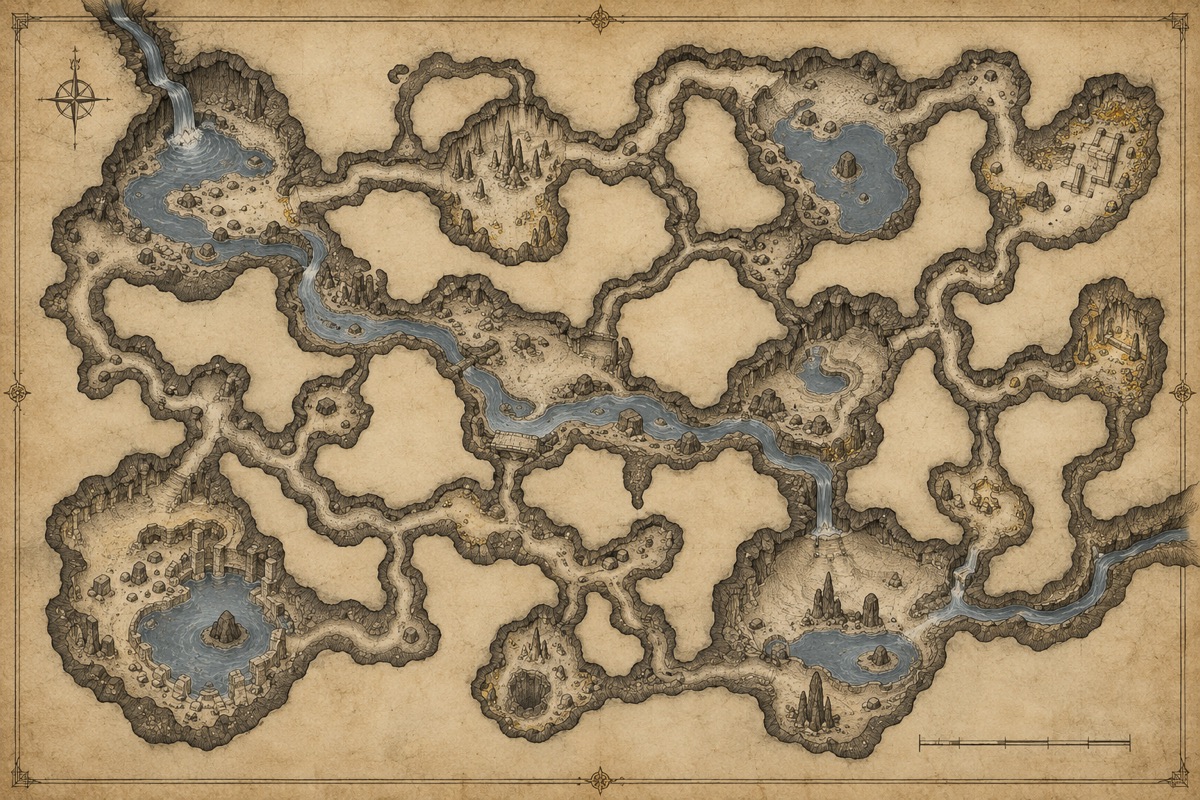
A useful cave map generator starts with decisions at the table, not with decoration. Use irregular shapes while preserving readable navigation. This guide uses a limestone cave with an underground stream as a running example so each recommendation can be tested against an actual location. You will see how to choose a scope, connect spaces, make the layout readable, and produce an export that remains useful when the session begins.
A cave map generator supplies irregular shapes quickly. The design task is to give those shapes believable geology and clear paths. In the running example, the stream that orients exploration gives that decision a visible reference point.
The central question is what the map must help players decide. In a limestone cave with an underground stream, the map should show enough structure to understand where a route might lead, yet leave room for discovery. Use irregular shapes while preserving readable navigation. Write that purpose in one sentence before opening a generator. If a later room, corridor, or icon does not support that sentence, ask whether it belongs on this particular sheet.
A cave map generator is useful when it communicates relationships: which spaces connect, which are separated, where people normally travel, and where trouble might interrupt that travel. The sample location calls for a narrow mouth, branching gallery, pool, and high chamber. These are functions, not mandatory labels. Change their names to fit your adventure, but preserve the logic that explains why each space sits where it does. A clear reason is more valuable than a large room count.
Field note: write the map's purpose at the top of your prep page. For a limestone cave with an underground stream, the sentence should explain why a narrow mouth, branching gallery, pool, and high chamber belong together. It becomes a useful filter when a generated chamber is attractive but has no role in the site.
Choose a scope that fits the session
Scope depends on how long the group will spend in the location. For a limestone cave with an underground stream, decide whether the whole site will be explored in one session or revisited over several. Count decisions rather than squares: each branch should offer information, risk, a reward, or a change in route. A short map with several distinct choices can occupy a table longer than a sprawling map of empty rooms.
Use an approximate room budget before generating. Allocate one space for arrival, a few for development, an optional detour, and a destination. The example's essential areas are a narrow mouth, branching gallery, pool, and high chamber. Leave breathing space between major moments. If you need a larger site, add a second map or level with a different purpose instead of stretching every corridor merely to fill the canvas.
Time check: count the scenes you expect to play in a limestone cave with an underground stream, then leave room for one unplanned detour. If the location has more developed rooms than your available session can support, mark which branch may be shortened without removing the finale.
Start with a believable spatial idea
Imagine how this place was built and used before it became an adventure. A limestone cave with an underground stream implies routes for ordinary occupants as well as visitors. Trace a normal day: where would someone enter, store supplies, work, gather, and leave? Put doors and passages along those paths. The result feels more convincing because the geometry explains behavior, not because every wall has a detailed texture. For a limestone cave with an underground stream, compare this advice with the practical route: a dry upper path and a wet lower path.
The spatial idea can be simple: a dry upper path and a wet lower path. This gives you a starting network with a reason to exist. Draw the broad connections first, then place a narrow mouth, branching gallery, pool, and high chamber. Keep dimensions approximate until movement works. At this stage you are solving a diagram, so avoid polishing line weight, color, or furniture. Those details are easier to judge once the main route is stable.
Water is an excellent organizing force. A stream enters somewhere, gathers in lower places, and leaves somewhere. Make the wet route visibly lower or rougher than the dry route, so the cave can be understood without numbered signposts. The risk to avoid here is organic shapes so noisy that room boundaries disappear; mark the consequence in your notes before export.
Reality check: trace how an ordinary occupant would travel between a narrow mouth, branching gallery, pool, and high chamber. A corridor that only exists to connect two generated shapes is easy to spot when no worker, resident, or visitor would choose it.
Build routes and choices
A good route should support a choice that players can understand. In the example, a dry upper path and a wet lower path. Ask what is visible at the decision point and what each direction seems to promise. One way may be safer but longer; another may be quicker yet exposed. The map does not need to reveal every consequence immediately, but it should provide enough clues that choosing feels intentional.
Loops are especially useful because they let players return with new knowledge, flank an obstacle, or retreat without simply reversing every step. Add a loop where it fits the location's original use. Avoid making every passage interchangeable. If two corridors connect the same rooms and offer the same sights, hazards, and travel time, either distinguish them or remove one. Readability improves when every connection earns its place. The risk to avoid here is organic shapes so noisy that room boundaries disappear; mark the consequence in your notes before export.
Route check: follow a dry upper path and a wet lower path with a pencil from both directions. If the second path changes nothing about access, information, or risk, reshape it until the alternative has a reason to be chosen.
Water can organize an underground map in different ways: compare this cave with Sewer Map Design Guide: Channels, Access, and Loops. For worked excavation rather than natural formation, see Mine Map Design Guide: Workings and Hidden Risks.
Give important rooms a role
Room functions help you improvise. For a limestone cave with an underground stream, start with a narrow mouth, branching gallery, pool, and high chamber. Give each important space one job in the building and one job in the adventure. A store can explain supplies while hiding a clue; a hall can provide orientation while becoming a confrontation site. This double duty makes the map feel dense with possibility without requiring dozens of chambers.
Not every room needs a fight or puzzle. A quiet chamber can establish history, show a consequence of an earlier event, or provide a place to regroup. Number rooms in your notes so you can find them quickly. If you rename a generated room, keep the number stable across your map and prep document. Consistent references prevent confusion when the group moves quickly or unexpectedly. In the running example, the stream that orients exploration gives that decision a visible reference point.
Room check: read the function of each chamber aloud without its number. If two spaces in a limestone cave with an underground stream sound identical, combine them or give one a different job. This keeps notes short and descriptions memorable.
Use landmarks and visual language
Landmarks reduce navigation friction. In this guide's example, the stream that orients exploration. It should appear in descriptions before the party reaches it, or be visible from multiple approaches. A landmark can be a large room, odd shape, stair, stream, statue, or opening to another level. The key is distinctiveness: players should be able to say where they are relative to it.
Use a restrained visual language. Make walls, floor, doors, hidden features, hazards, and exits distinguishable at the size the map will actually be displayed. A small legend is better than a crowded set of ornate symbols. If the map is shared with players, hide information they have not discovered or create a separate player version. Clarity matters more than mimicking the style of a published product. For a limestone cave with an underground stream, compare this advice with the practical route: a dry upper path and a wet lower path.
Landmark check: point to the stream that orients exploration on a zoomed-out export. If it disappears at the size your players will see, strengthen its shape or contrast rather than adding another label.
Add tension without blocking play
Tension works best when a hazard interacts with a choice. Organic shapes so noisy that room boundaries disappear is a warning sign: it consumes attention without adding useful play. Place a trap, locked route, or encounter where the group can notice clues, evaluate alternatives, and decide what to do. A hazard that appears without warning and blocks the only route is usually less interesting than one that changes the cost of a known option. For a limestone cave with an underground stream, compare this advice with the practical route: a dry upper path and a wet lower path.
Consider how the location responds to movement. Sound may travel through a dry upper path and a wet lower path; a guarded space may overlook the stream that orients exploration; an exit may be easy to reach but hard to use. Mark these relationships in short notes beside the map. They help you run the site consistently even when players act in an unexpected order. Keep essential progress possible without assuming a single solution.
Hazard check: test whether the risk can be recognized before it matters. In a limestone cave with an underground stream, avoid organic shapes so noisy that room boundaries disappear. Put evidence near a decision point and let players choose how to respond.
Make a worked example
For a worked example, sketch a limestone cave with an underground stream as a set of connected functions rather than a finished illustration. Begin with a narrow mouth, branching gallery, pool, and high chamber. Put the entrance where arrival makes sense, then choose a destination whose distance feels appropriate for the session. Add a dry upper path and a wet lower path. Finally, place the stream that orients exploration where it can help players orient themselves. You now have a playable graph even before choosing a theme.
Run three imaginary turns. First, the party enters and sees two plausible directions. Second, they explore an optional room and learn something that changes the meaning of the main route. Third, they approach the destination from either direction of the loop. If the choices sound indistinguishable, adjust one route. If the map requires a scripted sequence to work, loosen a connection or move a clue. The risk to avoid here is organic shapes so noisy that room boundaries disappear; mark the consequence in your notes before export.
Irregular rooms should still have a usable play area. A beautiful jagged outline that leaves only one narrow cell of traversable space may be difficult for tokens or printed markers. Smooth the inside of important chambers while keeping uneven edges outside. In the running example, the stream that orients exploration gives that decision a visible reference point.
Example check: imagine a group entering a limestone cave with an underground stream after missing your planned clue. Can the map still support a route toward the stream that orients exploration? If not, move a hint to a place that can be reached by more than one approach.
Translate the plan into generator settings
Open the relevant generator with a size that matches the room budget. For a limestone cave with an underground stream, generate a medium draft before trying a huge canvas. Set room count near the number of meaningful spaces you planned. Choose straight corridors for deliberate architecture or organic ones for excavated and natural sites. Turn on loops when the route diagram benefits from a return path, and use secret rooms only for optional discoveries.
Treat a seed as a version of the generated layout. Write down the seed and settings together, then make a new seed only when you want a different arrangement. Switch visual themes without changing geometry to compare readability. The current tool allows quick cell and symbol edits, then PNG, SVG, and JSON exports. A share URL reproduces generated settings and layout; manual edits belong in your exported file, so save that file separately. In the running example, the stream that orients exploration gives that decision a visible reference point.
Settings check: generate three seeds with the same room count and compare only the connections. Keep the version where a dry upper path and a wet lower path reads most clearly; a prettier silhouette is less useful if travel becomes confusing.
To test the route and room choices in this guide, open the cave map generator and compare a few seeds. Keep the version that helps you make caves feel natural without losing clarity.
Review common mistakes
The most common error is organic shapes so noisy that room boundaries disappear. It often looks acceptable while zoomed in, yet becomes obvious when you trace the route from the entrance. Another error is adding too many symbols before the room network is stable. Remove decorative marks temporarily and see whether walls, paths, and doors still communicate the plan. If not, fix geometry first.
Check every doorway at the map's real use size. A narrow gap may vanish in print; a secret symbol may be too prominent on a player handout. Verify that optional spaces remain optional, that a hidden route does not contain the only required clue, and that the final room is reachable. For encounter maps, also check movement width and sightlines. For exploration maps, check that players can form a useful mental picture. For a limestone cave with an underground stream, compare this advice with the practical route: a dry upper path and a wet lower path.
Revision check: identify one thing you will remove before adding anything. For a limestone cave with an underground stream, that may be a redundant room, a decorative symbol, or a corridor that duplicates a dry upper path and a wet lower path without creating a new choice.
Prepare the map for screen and print
Export for the medium you will use. If the map is projected or loaded into a virtual tabletop, start with a high-resolution PNG and inspect the grid at actual display scale. If it will be printed, choose a printer-friendly theme and test one page before producing a full set. SVG remains sharp when enlarged, while JSON preserves structured map data for your own notes or future tooling. For a limestone cave with an underground stream, compare this advice with the practical route: a dry upper path and a wet lower path.
Keep a game-master copy and, when needed, a player copy. The game-master version can retain room numbers and hidden marks; the player version should reveal only what you intend. Put the seed in your notes rather than across the visible play area unless it is useful to the group. Name exported files consistently so a revised map cannot be confused with an older one. When preparing a limestone cave with an underground stream, test the idea against the actual functions: a narrow mouth, branching gallery, pool, and high chamber.
Export check: open the downloaded file, not just the editor preview. Confirm that the stream that orients exploration, doors, and room numbers remain legible at the actual display or paper size you intend to use.
Test at the table and revise
Before the session, start at the entrance and trace each important room. Confirm that a dry upper path and a wet lower path is navigable and that the stream that orients exploration appears when your notes say it does. Try one unconventional player choice, such as retreating, bypassing a guarded space, or approaching the final area by a secondary path. The map should support that choice without requiring an emergency rewrite.
After a test, revise only what caused friction. If players could not tell two passages apart, add a landmark or different room function. If the site felt too linear, add a connection with a clear cost. If it took too long, remove a low-value room rather than shrinking every scene. The goal is to make caves feel natural without losing clarity; a map succeeds when it helps the table make and understand choices.
Table check: hand the map to someone who does not know a limestone cave with an underground stream. Ask them to point out the entrance, a secondary route, and a likely destination. Their hesitation reveals layout problems your own familiarity may hide.
Final review questions: Does the map show why a narrow mouth, branching gallery, pool, and high chamber belong together? Can someone reach the destination without guessing an invisible mandatory secret? Does a dry upper path and a wet lower path create a real alternative? Is the stream that orients exploration recognizable from the play distance? Have you saved a usable export and the seed? If those answers are clear, stop polishing and prepare the descriptions and consequences that make the location come alive.
Put it into practice
Try the Cave Map Generator and save the ideas that fit your campaign.