
Fantasy naming · 2026-10-07 · 2304 words
How to Name Fantasy Towns, Cities, and Taverns
Create memorable settlement and inn names that fit geography, history, maps, and spoken tabletop play.
Begin with the place, not a random word
A settlement name becomes more useful when it tells players something they can discover. Start with the place's physical job: a bridge town, hill fort, harbor, orchard market, or roadside refuge. Add one historical detail such as a former ruler, flood, fire, pilgrimage, or trade. These two facts give you a direction before you generate candidates. The town name generator can supply options, but your map and notes should decide which option belongs in the world.
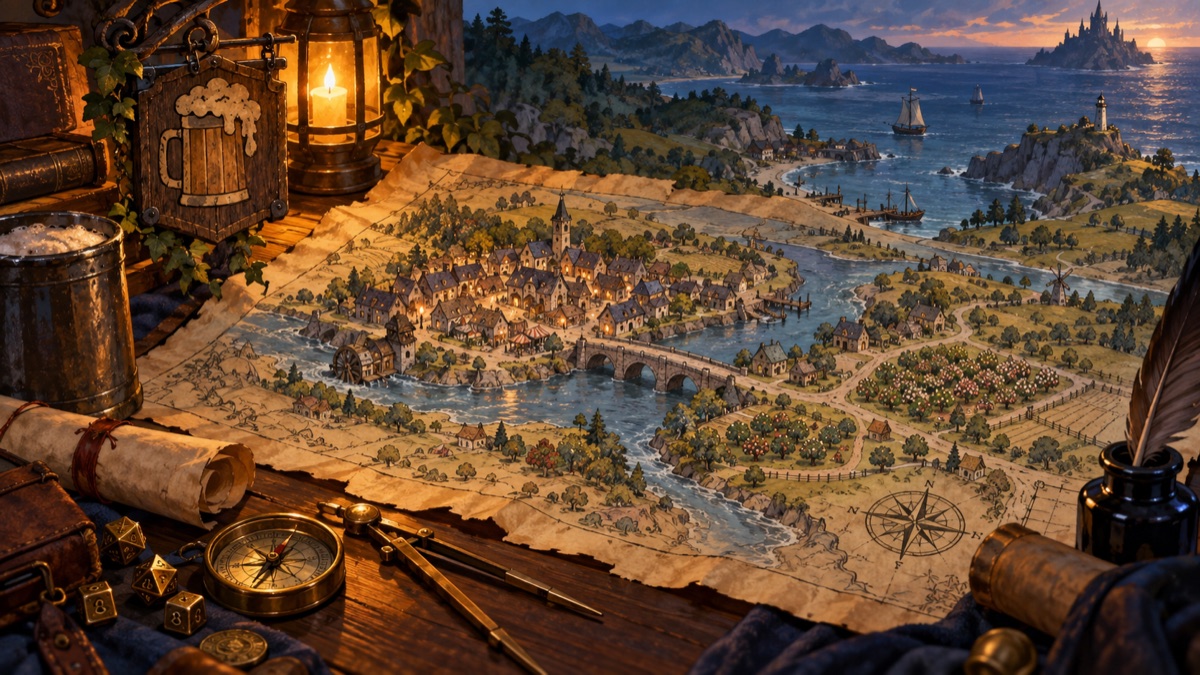
Try an example: a village sits where a narrow river meets an old stone road. Residents make their living repairing carts and guiding travelers across the water. A name referencing the crossing will feel earned because the bridge, market, and approach road appear in play. A name referencing a dragon could still work, but then the setting needs a reason for it: a carved memorial, a local story, or an actual event. A name is a promise about the place.
Do not write a full history for every hamlet. One visible feature and one human activity can be enough. The goal is to create a label that helps players picture the settlement and remember why they might return. If you can remove the name from one town and paste it onto any other without changing a detail, the choice is probably too generic. Give it a small anchor in terrain, economy, architecture, or shared memory.
Use geography as a naming engine
Terrain offers a wide but coherent vocabulary. Rivers produce fords, bends, mouths, and banks; hills produce ridges, crowns, steps, and overlooks; coasts produce coves, shoals, lights, and harbors. Choose the term locals would notice rather than the most dramatic word available. A fishing village may care more about a safe inlet than a distant mountain. A city that controls a pass may emphasize its gate or watch. The place's everyday use should guide its name.
A simple map test helps. Point to the settlement and ask which nearby feature a traveler would mention while giving directions. If the answer is a bridge, a grove, or a cliff, that feature can form the first half of a name. Then add a second element that separates it from similar places. The city name generator can help with larger urban names, but still check that the result works as a map label and a spoken destination.
Geography can also explain clusters of related names. Along one river, several villages might share a root referring to the water and vary by position or trade. This makes a region feel connected without forcing a dense language system. Keep the repeated element obvious enough to be noticed, but not so dominant that every location blurs together. If the party sees the names on a regional handout, they should be able to distinguish them at a glance.
Give towns an economy and a history
An economy shapes what a town calls itself. A mining settlement may name a seam, quarry, or founder; a market town may reference a fair or crossroads; an orchard village may borrow from a crop or season. The name does not have to describe current work. A former mill town might keep its old name after the river changes course. That mismatch can become a useful question for curious players. The more the name participates in local life, the less it feels pasted on.
History can explain surprising words. Perhaps an inn sign survived a fire, a saint's road attracted pilgrims, or a watchtower became the center of a neighborhood. Write a one-sentence origin in your notes, then decide whether anyone at the table needs to know it. Often they do not. The visible trace is enough: a cracked bell over a square, a ruined tower beside the road, or a festival that preserves an old surname. Avoid telling a legend when a detail in a scene can carry it.
Place names can change as power changes. A conqueror may impose a formal title while residents keep an older short name. Merchants might use a practical nickname that differs from the name on official maps. Use this sparingly and record every variant in the location ledger. Too many aliases can confuse players, but one carefully chosen contrast can reveal politics. Make it clear through context who uses which name, and ensure the party can still identify the destination.
Scale names from village to city
A village often needs a direct, easy name because players use it as a practical waypoint. A city can bear a more layered name if its districts, history, and reputation support it. Start with the function: port, capital, university, market, fortress, or pilgrimage center. Decide what an ordinary traveler calls it. The formal charter name can be longer, but the everyday version should fit naturally in dialogue. A city name generator is most helpful after you know the city's role.
Test the name at two sizes. Put it on a regional map, then say it in the sentence, 'The caravan leaves for ___ at dawn.' If the map label is cramped or the spoken form awkward, shorten it. You can keep the longer version for ceremonies and documents. This mirrors how many real settlements develop common shortened forms, but the fictional result should be designed for clarity rather than copied from a specific real place.
Capital cities often attract grand labels, yet grandeur can be expressed through context instead of syllable count. A short name may sound powerful when everyone in the setting understands its importance. Meanwhile, a small frontier town may have a long ceremonial name left by founders who hoped it would become a capital. That contrast can add character. Decide whether the difference is intentional; otherwise keep the naming hierarchy simple enough for players to read quickly.
Create a consistent regional palette
A region feels coherent when nearby places share some naming habits. Decide on a few recurring sounds, landscape terms, or structural patterns. For example, coastal places may favor two-part names tied to navigation, while upland settlements refer to stone and weather. This is a design system, not a rigid rule. The fantasy name generator can produce a wider starting pool, but edit results until they fit the palette you chose.
Avoid making every neighboring town rhyme. Variety matters for navigation, especially when the players travel between locations in the same session. Give each place a distinct opening sound and silhouette on the map. If three towns start with the same letter and end with the same suffix, the party may mix them up even if you can remember the difference. Read the whole route list aloud, then change the name that repeatedly causes hesitation.
Border regions can deliberately combine patterns. A settlement founded by one culture and ruled by another might have an old local name and a newer official one. A trade port may retain a foreign word because sailors keep using it. Such exceptions work best when they are few and connected to visible history. You do not need to build a complete language. A small naming palette plus one meaningful exception usually tells a clearer story than dozens of invented linguistic rules.
Name the tavern as a usable sign
Tavern names have a special job: a traveler must be able to recognize the sign. An animal, tool, plant, color, or local landmark can give you an image that belongs over the door. The tavern name generator offers combinations, but choose one you can draw or describe in a sentence. If the place is called the Bent Lantern, a crooked lamp outside can confirm the destination without an exposition paragraph.
Match the name to the establishment's role. A roadside inn may need a welcoming, obvious sign; a secret meeting place may hide its meaning behind an ordinary object. A grand city hotel may use a patron's surname or ceremonial emblem. Try saying, 'Meet me at ___ after sunset.' If the phrase sounds natural and specific, it is probably doing its job. If it sounds like a slogan, simplify it. The goal is a believable business that serves the setting.
Carry the name into the interior. A tavern called the Copper Fox might have copper lamps and a carved fox behind the bar, but you need only one or two echoes. Overdecorating every room can make the name feel like a theme park. If a tavern becomes an encounter location, place the sign, entrances, stairs, and gathering space clearly on a tavern map. Players can then connect what they heard in town to what they see during play.
Let names support navigation
Names are part of the interface for a campaign map. Players use them to form plans, compare routes, and remember where clues came from. Put the most important names where they can be read at the map's intended size. Avoid long labels that cover roads or landmarks. If a name is too long, use a short map form and keep the full form in the location key. Consistency between the map and spoken narration matters more than typographic flourish.
Give nearby places different first sounds. Players often hear the start of a name before they see it written, and early differentiation reduces confusion. If the campaign features two river towns, distinguish their roles too: one might be a toll crossing and the other a ferry market. Then the difference exists in both word and world. If players still confuse them, revise one label. Changing an unused place name is cheap; repairing a mistaken quest destination during play is not.
For a local dungeon, the name can direct attention without revealing secrets. A location called the Old Gate should show a gate, even if the mystery lies beyond it. A name like the Whispering Vault may promise sound, rumor, or acoustics. Use the dungeon map generator to build a location whose rooms support that promise. If the title has no connection to the actual space, players may treat it as a clue and feel misled.
Create a practical location ledger
Keep a ledger with the name, pronunciation, type of place, map position, visible landmark, and first session of use. Add any alias in a separate field. This prevents a location from shifting between notes and handouts. When the party returns months later, the stable spelling helps everyone recover the context. The ledger does not need to be elaborate. A small table or plain text list is enough if you update it after every session.
Separate ideas from established canon. A generated result is a candidate until the players hear it or see it on a shared map. Once used, the name should stay stable unless the change is an intentional story event. Save a seed with a group of unused candidate names so you can produce a similar style later. The name tool runs locally in the browser and can recreate a batch from the same settings; downloaded text is useful when you want a durable backup.
Check the ledger before adding another town, especially in a large region. Scan for repeated initials, similar endings, and duplicate descriptors. Compare the new name with places players already visit regularly. If the new settlement is deliberately related, a shared root can help; if unrelated, vary the sound. This short review makes your world feel more considered and saves the table from repeatedly asking which bridge town the characters are discussing.
Edit generated names with intent
Generate more candidates than you need, then shortlist by function. For a town, select names that fit its terrain and daily life. For a tavern, select names that produce a clear sign. For a city, select names that look clean on a map and work in speech. Do not choose solely by the most unusual spelling. A memorable place is usually made by what happens there; the name helps players find it again.
Edit one feature at a time. You might shorten a suffix, replace a repeated opening sound, or swap a landscape term to match the actual map. Then test the revised name in context. Say it as a direction from an NPC and write it on the map at normal scale. If the name resembles a famous fictional location or an unintended real word, choose another. Original component banks reduce repetition but cannot guarantee that every combined result is globally unique.
Ask what the inhabitants call themselves. A place name often produces a resident term, adjective, or business name. If none of those forms can be spoken comfortably, the place may be harder to use over a long campaign. You can create a shorter local nickname instead. Keep the two forms in the ledger and decide which characters use each. This small exercise often exposes awkward names before they become fixed in multiple handouts.
Turn a name into an adventure hook
A good place name can invite a question. Why is a town called Watcher's Rest when its tower is empty? Why does an inn display a silver key when no guest room has a lock? The answer need not be a major plot. It can be local history, a useful rumor, or a clue toward an optional encounter. Let the map show part of the answer. A carved sign, abandoned road, or altered gate makes the name feel grounded.
Avoid making every name a mystery. Ordinary descriptive names give the setting texture and provide contrast for the one place whose label matters. If every village carries a dark secret, players stop treating any particular name as a signal. Decide which locations deserve investigation and which simply help navigation. A name can be memorable because it is practical, warm, or funny; not every word needs to foreshadow a twist.
Finish by pairing each important name with one visible detail and one usable action. The town has a bridge and buys ore. The tavern has a copper sign and hosts travelers. The city has a sea wall and controls the ferry. This compact preparation is enough to make the location playable. Generate candidates with the name generator, then let the geography, people, and session needs choose the final wording.
Put it into practice
Try the Town Name Generator and save the ideas that fit your campaign.